McCarthy's Oversight Abuses
McCarthy's Oversight Abuses Snapshot
During the early years of the Cold War, fears of communist infiltration, commonly called the “Red Scare,” shaped American politics and public opinion. No person better exemplified this period in American history than the one who lent it his name – Joseph McCarthy.
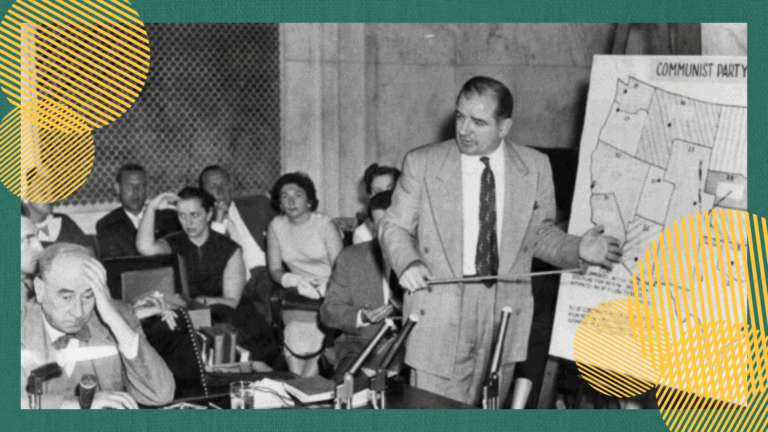
McCarthy’s dogged pursuit of communists, LGBTQ+ individuals, and other so-called “subversives”, which became known as “McCarthyism”, is perhaps the most notorious and high-profile abuse of the congressional oversight power in U.S. history. In this Snapshot, students read a short background on Joseph McCarthy and his rise to political prominence in the mid-to-late 1950s. Students learn about the tactics that McCarthy used against his opponents and the ways he targeted both suspected communists and LGBTQ+ individuals in the federal government. Emphasis is placed on the infamous Army-McCarthy hearings, where Joseph McCarthy’s attacks on the Army led to public, televised hearings which horrified the American people, and ultimately led to his censure by the Senate for abuse of a Senate Committee. By examining Senator Joseph McCarthy’s investigations and the public response to his tactics, students gain historical context for understanding both the purpose and the limits of congressional investigative power.
Our snapshot of McCarthy’s congressional oversight abuses is a classroom-friendly version of our Portrait in Oversight on the same topic. Each of our snapshots is a brief summary of the historical investigation.
To enhance accessibility and support for multilingual learners, each download includes:
- Comprehension Questions
- These questions guide students through the ways in which Senator McCarthy used the Senate’s Permanent Subcommittee on Investigations to advance his anti-communist and anti-LGBTQ+ agenda, as well as the tactics McCarthy used, his eventual downfall, and the reforms enacted as a result of his abuses.
- Discussion Questions
- These prompts encourage deeper analysis. Suggested questions are:
- What else was happening in the United States in the 1950s and 1960s that allowed for the “Red Scare” to be so effective? Why do you think we hear less about the “Lavender Scare?”
- Who really had the power to stop McCarthy?
- Answer Key
- Teacher support materials that provide clear responses to both comprehension and discussion questions, making it easier to review student work and facilitate classroom discussion.
- Audio, Spanish, and Arabic Versions
- Audio, Arabic, and Spanish versions of the summary present the historical narrative in an accessible format, allowing students to engage with the content in a way that is accommodating to them.
- These prompts encourage deeper analysis. Suggested questions are:

What were Joseph McCarthy’s oversight abuses?
I think it is high time that we remembered that we have sworn to uphold and defend the Constitution. I think that it is high time that we remembered that the Constitution, as amended, speaks not only of the freedom of speech but also of trial by jury instead of trial by accusation. Whether it be a criminal prosecution in court or a character prosecution in the Senate, there is little practical distinction when the life of a person has been ruined.
Senator Margaret Chase Smith
During the height of the Cold War, widespread fears of communist infiltration, as well as prejudice against LGBTQ+ individuals, created pressure for aggressive congressional investigations. Senator Joseph McCarthy’s use—and abuse—of the Senate’s oversight authority became one of the defining episodes of the Red Scare, prompting major reforms to congressional investigative procedures and reinforcing constitutional protections for individuals called before congressional committees. This lesson provides students with historical context for evaluating both the importance and the limits of government oversight in a constitutional democracy.
Content Standards
This snapshot aligns with Michigan social studies content standards and helps students quickly contextualize domestic anti-communism sentiments during the post-war years of the mid-to-late 1950s. Students learn about the role that Joseph McCarthy played in perpetuating the “Red Scare,” and the ways in which he abused the power of Congressional oversight to violate the civil liberties of Americans.
MI USHG – 8.2.2 Analyze major domestic issues in the post-World War II era and the policies designed to meet the challenges by:
- describing issues challenging Americans, such as domestic anticommunism (McCarthyism), labor, poverty, health care, infrastructure, immigration, and the environment.
- evaluating policy decisions and legislative actions to meet these challenges.
Once you fill out this form, you will be redirected to our download page.
**If you have already filled out the download form, please look in your inbox for an email from LbH.LevinCenter@wayne.edu for a link to the download page.**
Can’t see the form below? Click here to access it.