Ferdinand Pecora and the 1929 Stock Market Crash
Stock Market Crash Lesson Plan
This lesson designed for high school U.S. history students, explores the history of financial regulation, and the Senate Banking and Currency Committee’s investigation of the 1929 Stock Market Crash. It later became known as the Pecora Committee, after its lead lawyer Ferdinand Pecora. This investigation helped reshape the relationship between government, financial institutions, and the American public during the Great Depression, and continues to influence government regulation today.
The lesson engages students in the work of historical investigation by examining primary source documents, newspaper articles, constituent correspondence, and congressional reports. Students analyze competing perspectives on the causes of the stock market crash and evaluate how lawmakers responded to public demands for accountability and reform.
By studying the work of Ferdinand Pecora and the Senate investigation that bears his name, students learn how congressional hearings can expose wrongdoing, influence public opinion, and shape public policy. The lesson highlights the connection between economic crises, democratic institutions, and government efforts to protect citizens from financial misconduct. Students will leave the lesson being able to answer the compelling question “How did the Pecora Committee’s findings change government regulation of the stock market and banking industry?”

This free download includes:
- Lesson plan
- A two-day inquiry lesson that guides students through the Pecora Investigation, the 1929 Stock Market Crash, and the congressional hearings that helped shape New Deal financial reforms.
- Primary and Secondary sources
- A letter from Harry Fein to Senator Duncan Fletcher supporting securities reform.
- Excerpts from Pecora Committee hearings with P. Morgan, Jr. and Richard Whitney.
- Excerpt from a 1934 New York Times article showing criticism of the Fletcher-Rayburn bill, later known as the Securities Exchange Act of 1934.
- A classroom-friendly historical overview that introduces Ferdinand Pecora, explains the origins and findings of the investigation, and traces how the committee’s work contributed to landmark financial reforms during the New Deal era.
- Student Worksheets
- Graphic organizers and guided comprehension questions that encourage students to analyze historical perspectives, build empathy, and connect national policy debates to the experiences of everyday Americans.
- Summative Assessment that asks students to assume the role of a US Senator and defend or oppose major financial reform legislation using evidence from the investigation.
- Answer Key
- Teacher support materials that provide guidance for student responses and class discussion. Includes a completed key that contains evidence-based sample answers, and suggested responses for comprehension questions, and the final assessment.
Throughout the lesson, students investigate how congressional oversight can influence public policy during times of national crisis. Key questions include:
- How did Ferdinand Pecora’s investigation uncover abuses within the banking and securities industries?
- Why did many Americans believe stronger regulation of financial institutions was necessary?
- What reforms were created to protect investors, bank depositors, and the broader economy?
Students answer the inquiry question “How did the Pecora Committee’s findings change government regulation of the stock market and banking industry?” helping students to explain how modern economic regulations came into being, and how government has acted in the past to rebuild public trust after a crisis.
Stock Market Crash Snapshot
Our snapshot of the Pecora Committee is a classroom-friendly version of our Portrait in Oversight on the same topic. Each of our snapshots is a brief summary of the historical investigation.
To enhance accessibility and support for multilingual learners, each download includes:
- Comprehension Questions
- These questions guide students through the key events of Congress’ investigation of the stock market crash of 1929, helping them identify what led to the investigation, who was involved, and why it played such a large role in protecting the American economy from future depressions. Students are also asked to think about the tools Congress uses to conduct oversight, including subpoenas, hearings, witness testimony, and investigative research.
- Discussion Questions
- These questions ask students to reflect on the significance of calling powerful financiers to account in a public forum, along with the importance of bipartisanship to the investigations’ influence and legacy.
- Answer Key
- Teacher support materials that provide clear responses to both comprehension and discussion questions, making it easier to review student work and facilitate classroom discussion
- Audio and Spanish Versions
- An audio version and a Spanish version of the summary present the historical narrative in an accessible format, allowing students to engage with the content in a way that is accommodating to them.
Stock Market Crash Video
We’ve partnered with Detroit PBS to bring you our Portraits in Oversight video series. Our video on Ferdinand Pecora and the 1929 Stock Market Crash is designed for use in the classroom and features expert commentary.
How did the Pecora Investigation lead to financial reform?
The breakdown of 1929 was the result of willful mismanagement and violation of every principle of sound finance. It was the outcome of vulgar greed at the cost of the community. It has been a national disgrace and a source of untold national and individual loss. In paying the bill for it, the American people should think seriously about how they can best avoid running up another.
H. P. Willis, Who Caused the Panic of 1929?
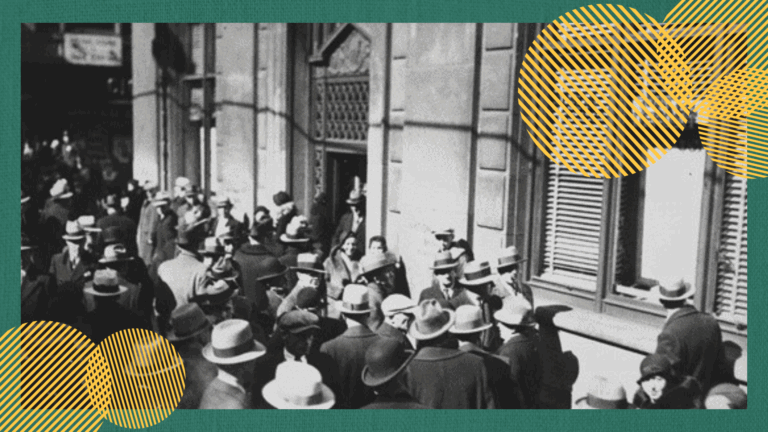
During the 1920s, the United States experienced rapid economic growth, rising stock prices, and widespread speculation in financial markets. Many Americans invested heavily in stocks, often borrowing money to do so. At the same time, banks, investment firms, and stock exchanges operated with limited government oversight. Financial institutions frequently engaged in practices that were poorly understood by the public and largely unregulated by federal authorities.
The stock market crash of October 1929 triggered a broader economic collapse that became known as the Great Depression. Millions of Americans lost jobs, savings, homes, and businesses. As the crisis deepened, lawmakers sought to determine why existing financial institutions had failed to protect investors and the economy. Early congressional investigations produced limited results, but the inquiry gained momentum after attorney Ferdinand Pecora joined the Senate Banking and Currency Committee in 1933.
Pecora expanded the investigation, secured critical financial records, and conducted highly publicized hearings that revealed unethical and reckless practices among some of the nation’s most powerful bankers and financial executives. Citizens had never seen such influential men held accountable in this way before. The hearings uncovered misleading investment information, insider advantages, market manipulation, conflicts of interest, and other abuses that had contributed to public distrust of Wall Street.
The investigation’s findings helped build public and bipartisan support for major reforms. Congress responded by passing the Glass-Steagall Banking Act of 1933, the Securities Act of 1933, and the Securities Exchange Act of 1934, which created the Securities and Exchange Commission (SEC). Together, these laws increased transparency, strengthened investor protections, regulated securities markets, and expanded federal oversight of the financial system. The Pecora Investigation became one of the most influential congressional investigations in American history and demonstrated how oversight can lead to significant policy change.
Content Standards
Aligned with Michigan social studies content standards, this lesson develops students’ understanding of the causes and consequences of the Great Depression while examining how congressional investigations, public participation, and government institutions influence public policy and economic reform. Through analysis of primary sources and historical evidence, students build critical thinking, civic reasoning, and evidence-based argumentation skills.
MI USHG – 7.1.2 Causes and Consequences of the Great Depression. Explain and evaluate the multiple causes and consequences of the Great Depression by analyzing:
- the political, economic, environmental, and social causes of the Great Depression, including fiscal policy, overproduction, underconsumption, speculation, the 1929 crash, and the Dust Bowl.
- the economic and social toll of the Great Depression, including unemployment and environmental conditions that affected farmers, industrial workers, and families.
MI Civics – 3.3.1 Describe and analyze how groups and individuals influence public policy.
MI Civics – 3.3.5 Identify and discuss roles of non-governmental organizations in American civic society.
Once you fill out this form, you will be redirected to our download page.
**If you have already filled out the download form, please look in your inbox for an email from LbH.LevinCenter@wayne.edu for a link to the download page.**
Can’t see the form below? Click here to access it.