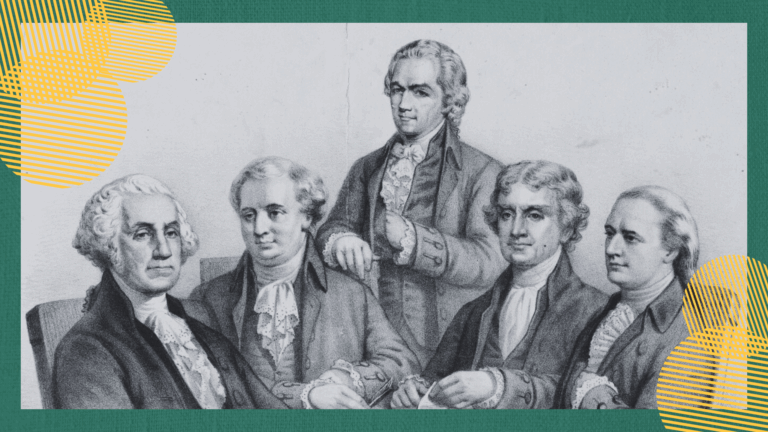
Note: Our content on America’s first congressional investigation focuses on the history and development of legislative oversight as an essential element in good governance. Our efforts to capture this moment in history do not condone the treatment of Indigenous Americans by the U.S. government during that period. For more information about teaching about Native experiences with cultural competency, read the Framework for Essential Understandings about American Indians created by the Smithsonian National Museum of the American Indian.
General St. Clair's Defeat Lesson Plan
This lesson examines how moments of national crisis can clarify the constitutional roles and responsibilities of the legislative and executive branches of the United States government. Centered on the historical case of General Arthur St. Clair’s 1791 military defeat, students investigate how this early failure prompted a significant debate over the role of Congress in conducting oversight investigations. Designed for secondary students studying U.S. history or civics, the lesson aligns with standards focused on separation of powers and checks and balances, asking learners to evaluate how authority is distributed and exercised in practice.
Students engage directly with a range of primary sources and historical case materials, including excerpts from the U.S. Constitution, the Federalist Papers, congressional debates, and correspondence between key figures such as George Washington and General Arthur St. Clair. Through activities such as source analysis, annotation, and a Structured Academic Controversy, students assess competing arguments about constitutional authority and institutional responsibility. These activities require students to interpret evidence, construct arguments, and consider multiple perspectives on a complex civic issue.
The inquiry is guided by the Compelling Question: “How can a crisis clarify the roles of Congress and the President?” Supporting questions focus student analysis on both the events of St. Clair’s defeat and the subsequent debate over who should lead the investigation: Congress or the President? Ultimately, students synthesize their learning in a collaborative podcast assessment. By connecting historical investigation to broader constitutional principles, students develop a deeper understanding of how crises can shape—and clarify—the balance of power within the American political system.

This free download includes:
- Lesson Plan
- A two-day inquiry lesson that guides students through the events of General St. Clair’s defeat and the first congressional oversight investigation that followed.
- Primary Sources
- Historical documents from the 1792 investigation that allow students to examine how Congress and President Washington responded to a national crisis.
- Student Worksheets
- Activities that help students learn about the outcome of the Battle of the Wabash and analyze how the subsequent investigation clarified the roles of Congress and the executive branch.
- Answer Key
- Teacher support materials that provide guidance for assessing student understanding of the historical events and oversight outcomes.
This lesson is structured around a Compelling Question that guides student investigation into the balance of power within the U.S. government: How can a crisis clarify the roles of Congress and the President? Using the historical case of General St. Clair’s defeat, students examine how a moment of national failure prompted debate over constitutional authority and institutional responsibility.
To build toward this understanding, students engage with a series of supporting questions that scaffold their primary source analysis. First, they investigate what happened to the Army under General St. Clair and why it became such a significant national issue, grounding their learning in the historical context of the Battle of the Wabash. They then explore why Congress, and not the President, ultimately took the lead in investigating the defeat, analyzing competing interpretations of constitutional power through primary sources such as the U.S. Constitution, the Federalist Papers, and congressional debates. Together, these inquiry-based lesson guides students in evaluating how crises expose tensions within the system of checks and balances and help define the roles of each branch of government.
Snapshot
Our snapshot of General St. Clair’s Defeat is a classroom-friendly of our Portrait in Oversight on the same topic. Each of our snapshots is a brief summary of the historical investigation. To enhance accessibility and support for multilingual learners, each download includes:
- Comprehension Questions
- These questions guide students through the key events and outcomes of the investigation of General St. Clair’s defeat, helping them identify what led to Congress’ first investigation, who was involved, and why the defeat and subsequent investigation mattered. The questions check students’ understanding of the historical narrative while reinforcing core concepts such as oversight, accountability, and the separation of powers.
- Discussion Questions
- The discussion questions prompt deeper analysis and classroom conversation by asking students to connect this early investigation to broader constitutional principles. Students examine how the inquiry changed relationships between Congress, the President, and the military, and how congressional investigations function as a check and balance within the federal government.
- Answer Key
- The answer key provides clear, concise responses to both the comprehension questions, making it easy for educators to review student work and facilitate discussion.
- Audio Recording
- The audio version presents the full snapshot narrative in an accessible format, allowing students to listen to the historical account of General St. Clair’s defeat and the subsequent congressional investigation. This supports different learning styles and can be used for independent review or group listening.
- Spanish Translation
- Translated material ensures broader classroom accessibility and support for multilingual learners and inclusive instruction.
Video
Congress’ investigation of General St. Clair’s defeat marked the first major congressional oversight investigation in United States history. This classroom-ready video explains how lawmakers examined the causes of the military disaster, illustrated the differences between enumerated and implied powers of Congress, and clarified the roles of Congress and the President in overseeing the executive branch.
Video produced in partnership with Detroit PBS.
What was St. Clair's Defeat?
"The following pages contain the history of a very unfortunate campaign, the conducting of which had been committed to me; of the success of which very sanguine expectations had been formed: and that, by the effects of it, peace would be restored to the United States, and safety to the inhabitants of the western country; to which quarter great numbers of people, invited by the mildness of climate and the fertility of the soil, had removed."
General Arthur St. Clair, A Narrative of the Manner of the Campaign Against the Indians Under the Command of General St. Clair, by Major General St. Clair (1812)
In the early years of the United States, westward expansion into the Ohio River Valley brought the federal government into conflict with Native American tribes already living in the region. This conflict escalated into what became known as the Northwest Indian War. In 1791, President George Washington ordered General Arthur St. Clair to lead a military campaign to assert U.S. control over the territory. However, St. Clair’s forces were caught off guard near the Wabash River and suffered a devastating defeat at the hands of a Native American coalition in what became known as the Battle of the Wabash. The loss was one of the worst in early U.S. military history and immediately raised concerns about leadership, planning, and accountability.
In the aftermath of the defeat, government leaders faced a critical question: who had the authority to investigate what went wrong? As commander-in-chief, the President appeared responsible for military oversight, but Congress had constitutional authority over funding, regulation, and oversight of the armed forces. This ambiguity led to a significant debate between the executive and legislative branches over who should lead the inquiry. President Washington expressed limitations in conducting a military investigation, while members of Congress argued that, as representatives of the public and stewards of government spending, they had both the right and responsibility to investigate the failure.
Ultimately, the House of Representatives established a committee to examine the causes of the defeat, marking one of the first major congressional investigations in U.S. history. This decision helped clarify the role of Congress in overseeing the executive branch, particularly in matters involving public funds and military operations. The events surrounding St. Clair’s defeat thus provide a clear example of how a national crisis can expose uncertainties in constitutional roles and lead to a more defined balance of power between branches of government.
Content Standards
This inquiry-based middle and high school U.S. history lesson supports Michigan social studies content standards by examining how early congressional oversight emerged in the years following the creation of the Constitution and how key individuals, including members of Congress and President Washington, shaped the norms of American constitutional government through their roles in this investigation.
MI USHG — F1.2 Using the American Revolution, the creation and adoption of the Constitution, and the Civil War as touchstones, develop an argument about the changing character of American political society and the roles of key individuals across cultures in prompting/supporting the change.
Once you fill out this form, you will be redirected to our download page.
**If you have already filled out the download form, please look in your inbox for an email from LbH.LevinCenter@wayne.edu for a link to the download page.**
Can’t see the form below? Click here to access it.