Welcome to the Jungle
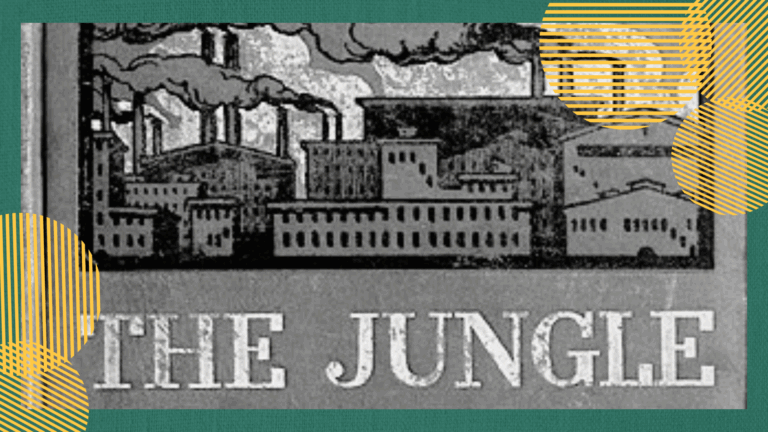
The Jungle Lesson Plan
This lesson examines the role of investigative journalism, scientific research, and congressional action in shaping early 20th-century food safety laws during the Progressive Era. Designed for secondary students studying U.S. history, the lesson centers on the compelling question: “Would the food regulation laws of the early 20th century have happened without the publication of The Jungle?” The lesson situates students within a broader civic issue: how evidence, public opinion, and government institutions interact to influence policy outcomes.
Students use an inquiry-based approach, analyzing a range of primary sources, including excerpts from Upton Sinclair’s The Jungle, the Neill-Reynolds Report, and findings from Harvey Wiley’s congressionally funded hygienic table trials, better known in the press as “The Poison Squad.” Through structured supporting questions, students identify food safety issues revealed through scientific investigation, evaluate the reliability of Sinclair’s claims, and examine how Congress responded with legislation such as the Pure Food and Drug Act and the Meat Inspection Act. Activities include collaborative source analysis, corroboration of evidence, and the development of evidence-based claims.
Throughout the lesson, students are positioned as investigators tasked with weighing evidence and determining causation. They synthesize information from multiple sources, compare proposed solutions to actual government actions, and ultimately formulate a reasoned response to the compelling question. By engaging directly with historical documents and policy outcomes, students gain insight into the mechanisms of reform and the ongoing relationship between public awareness, media influence, and government responsibility.
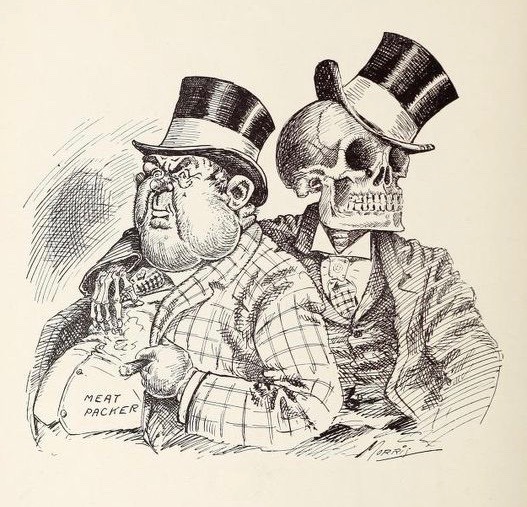
“The Chicago meat packer and his silent partner.” 1906
This free download includes:
- Lesson Plan
- A structured three-day inquiry lesson that guides students through the historical context of Progressive Era reform and congressional investigations into the meatpacking industry and food safety reforms.
- Primary Sources
- Historical documents and excerpts that allow students to examine the public reaction to The Jungle and the evidence considered during congressional investigations on food safety.
- Student Worksheets
- Activities that help students analyze historical evidence, evaluate the influence of public opinion, and consider how investigations can lead to policy change.
- Answer Key
- Teacher support materials that provide guidance for assessing student responses and facilitating classroom discussion about Progressive Era reform and the development of food safety laws.
This lesson examines how congressional investigations and public pressure helped shape food safety regulations during the Progressive Era. By analyzing evidence from Dr. Harvey Wiley’s congressionally funded , along with excerpts from The Jungle by Upton Sinclair, students explore how both public opinion and government data influence lawmakers and lead to major policy changes.
Through primary source analysis and classroom discussion, students explore questions such as:
- What did the Poison Squad experiments reveal?
- How accurate was Upton Sinclair’s The Jungle?
- What did the US Government do with the evidence from the Hygienic Table Trials (Wiley) and the Neill-Reynolds Report (Sinclair)?
This inquiry-based approach encourages students to evaluate historical evidence and consider how democratic institutions respond to public pressure and national concerns.
What led to the 1906 U.S. food safety laws?
There was never the least attention paid to what was cut up for sausage; there would come all the way back from Europe old sausage that had been rejected, and that was moldy and white – it would be dosed with borax and glycerin, and dumped into the hoppers, and made over again for home consumption.
Upton Sinclair, The Jungle
The historical context for this lesson begins in the late 19th and early 20th centuries, a period marked by rapid industrialization and urbanization in the United States. As food production shifted to large-scale industrial operations, oversight failed to keep pace. Food manufacturers commonly used chemical preservatives and additives—often undetectable to consumers—to extend shelf life or improve appearance. At the same time, meatpacking facilities operated under unsanitary conditions, raising concerns about public health. These issues emerged gradually, but early regulatory efforts were inconsistent and limited in scope, leaving consumers largely unprotected.
In response to growing concerns, Dr. Harvey Washington Wiley, chief chemist of the U.S. Department of Agriculture, initiated a series of controlled human experiments known as the Hygienic Table Trials, or “Poison Squad” experiments, beginning in 1902. These studies demonstrated that commonly used food additives such as borax and boric acid could cause significant harm to human health over time. Although Wiley’s findings provided scientific evidence of the dangers posed by unregulated food production, they did not immediately lead to widespread reform. Industry resistance and limited political urgency slowed government action, even as reports documenting these risks accumulated.
Public awareness and political momentum shifted dramatically following the publication of Upton Sinclair’s novel The Jungle in 1906. Although intended to expose labor conditions, the book vividly described unsanitary practices in the meatpacking industry, provoking widespread public outrage. In response, President Theodore Roosevelt authorized an independent investigation by Charles Neill and James Reynolds. Their report confirmed many of Sinclair’s claims, documenting poor sanitation, inadequate inspection systems, and misleading labeling practices. This convergence of scientific evidence, investigative journalism, and public pressure created the conditions necessary for rapid federal action.
The investigation culminated in a series of legislative reforms in 1906, including the Pure Food and Drug Act and the Federal Meat Inspection Act. These laws established federal authority to regulate food safety, mandate inspection processes, and require accurate labeling. The sequence of events—from early scientific inquiry to public exposure, to government investigation and reform—illustrates how multiple forces combined to produce meaningful policy change during the Progressive Era.
Content Standards
This inquiry-based high school U.S history lesson plan aligns with Michigan social studies content standards and supports instruction in U.S. history by helping students analyze Progressive Era reform, the influence of public opinion on government action, and the role of congressional investigations in shaping public policy.
MI USHG – 6.3.1 Describe the extent to which industrialization and urbanization between 1895 and 1930 created the need for progressive reform.
MI USHG – 6.3.2 Analyze the social, political, economic, and cultural changes that occurred during the Progressive Era.
MI Civics – 3.2.1 Describe limits the U.S. Constitution places on power of the states and on the federal government’s power over the states.
MI Civics – 3.3.1 Describe and analyze how groups and individuals influence public policy.
MI Civics – 3.3.3 Explain the concept of public opinion, factors that shape it, and contrasting views on the role it should and does play in public policy.
Once you fill out this form, you will be redirected to our download page.
**If you have already filled out the download form, please look in your inbox for an email from LbH.LevinCenter@wayne.edu for a link to the download page.**
Can’t see the form below? Click here to access it.